Thursday, January 23, 2025

Proposed De minimis Rules

 Last week, Customs announced a proposed change to the rules for de minimis procedures. After reviewing the proposal, I’ve summarized the key points below.

Currently, there are two methods for de minimis clearance:

  1. Manifest Clearance (Section 321 Line Release):

    • This method allows for filing shipments, including those subject to quota, ADD (anti-dumping duties), CVD (countervailing duties), or PGA (partner government agencies) requirements.
    • However, under the proposed rule, the line release process will no longer be available.
  2. Type 86 Entry:

    • This will become the primary process for de minimis shipments.
    • Eligible shipments under Type 86 exclude those subject to ADD, CVD, and any shipments "precluded by law."
    • The proposal does not clarify what "precluded by law" means, leaving room for interpretation. For example, a handgun without an ATF permit may be ineligible, but one with an ATF permit and Form 6A might qualify.

The comments on the rule also noted that shipments subject to quotas or IRS taxes (e.g., alcohol and tobacco) would not be eligible. However, the proposed rule itself does not explicitly mention these exclusions.

$800 Per Person Rule:

The $800 per person de minimis threshold will remain in effect. Customs has been testing enforcement and will require informal entries if they identify multiple shipments purchased by the same person on the same day, even if from different sellers, totaling over $800.

Who Can Make Entry?

Entries can be made by:

  • The owner (seller or manufacturer),
  • The consignee (e.g., a 3rd-party receiving warehouse),
  • The purchaser, or
  • A Customs broker appointed by any of the above.

Although Customs brokers are not required, I believe we offer valuable expertise in data processing that makes our services worthwhile.

Required Data:

For Type 86 entries, the following information will be required:

  • House bill of lading
  • Country of origin
  • Shipper’s name, address, and country
  • Name and address of the exemption claimant
  • Specific description of the goods
  • Manifest quantity
  • Shipment weight
  • Fair retail value
  • Name and address of the final delivery recipient

Enhanced Data Requirements:

The enhanced process will require additional details, such as:

  • Tracking number or house bill of lading
  • Export country
  • 10-digit HTSUS classification (with a procedure to waive this in certain cases, e.g., for websites selling a variety of apparel)
  • Supporting documentation, which may include:
    • URL to marketplace listing
    • Product pictures
    • X-rays by the consolidator
    • Product identifiers
  • Seller’s name and address
  • Purchaser’s name and address
  • PGA documentation
  • Advertised retail description
  • Marketplace website or contact information

Other Key Points:

  • Section 301 duties (tariffs) are rumored to be excluded from this procedure, but I could not find this in the proposed rule.
  • On today’s bi-weekly trade call, we learned that Lacey Act declarations will not be required for de minimis shipments.

Comment Period:

There is a 90-day public comment period for this proposed rule. I have several questions I’d like to ask and would appreciate hearing others' thoughts. Please share your comments or insights!

Friday, July 14, 2017

Presidential Investigation of Aluminum and Steel Imports Launch under Section 232 to Protect National Security.

On April 20, 2017, President Trump issued a memorandum, requesting the Commerce Department initiate a section 232 investigation on steel imports. A week later, April 27, 2017, the President issued another memorandum to investigate aluminum imports. The preliminary hearing for the steel investigation was held on May 24, 2017 and the preliminary hearing for the aluminum investigation was held on June 22, 2017.
A 232 investigation refers to section 232 of the 1962 Trade Act. It is encoded in law under 19 U.S.C. 1862. It allows the executive branch to place column 1 rate of duty on imports, or apply other trade remedies, on imported products to protect national security interests. The stated goal is to guarantee that the U.S. domestic production remains sound enough to meet the needs of the military. The law allows control of imports when the national security is at stake.
The procedure, for creating a section 232 remedy, starts with a request to investigate. After the Commerce Department receives a request, to initiate an investigation under section 232, the Commerce Department will notify the Defense Department of the investigation. Then Defense Department with communicate with the Commerce Department the supply needs of the Defense Department of those subject imports  Originally the Treasury Department was assigned these investigations, but since 1979 it has been handled by the Commerce Department.
The Commerce Department investigates and determines the current needs of the military compared with the current domestic production. The Commerce Department is required to issue a report detailing its finding as to whether imports are damaging national security within 270 days of receiving the request. Commerce presents the report to the President. The President, based on the report, then decides, if there is a threat, what action to take.

History of Section 232 Investigations.

Section 232 was passed, in 1962, during the cold war. When the law was passed there was a fear that United States industries might become too reliant on foreign producers. If those industries were weakened, the United States might not to be able to provide defense in case of an attack. Since the law was passed, there have only been 26, Section 232 Investigations in 55 years.
Of those 26, Section 232 Investigations, Commerce or the Treasury Department, determined that there was no threat to national security in 15 investigations. After four other investigations, the President determined that there was no action required to protect national security. Seventy-three percent of the Section 232 Investigations have ended with no action.
Of the remaining cases, there were four cases that had to do with oil. Two of the oil cases were country specific, and lead to total embargoes against Libya and Iran. These definitely were more geopolitically motivated. They had little to do with maintaining supplies of domestic resources for the purpose of national security. The other two petroleum investigations, also achieved very little to affect trade. One actually eliminated petroleum quotas, and imposed a fee system, that was later overturned by court order. The result was the Section 232 Investigations removed restrictions on importing oil for national security.
The final two Section 232 Investigations, also had minimal effects on trade. One case lead to a voluntary restraint agreement (VRA). Japan and Taiwan, both agreed to restrict exports of machine tools for five years. The other merely resulted in a plan, for the Defense Department, to stockpile certain ferroalloys, for a ten year period. The farthest a Section 232 Investigation has ever gone, was the imposition of VRAs, on certain machine tools, from two countries.

Why are Steel and Aluminum Being Targeted?

Steel making is extremely capital intensive. Turning raw iron ore into steel is a process that requires coke production, and basic oxygen furnaces. Coke production is expensive to stop once started. Coke is made by heating coal up to very high temperatures for 14 to 36 hours in ovens that are stacked side by side to transfer heat between the ovens. Once a set of ovens is started, it is more cost effective to keep them running continuously.
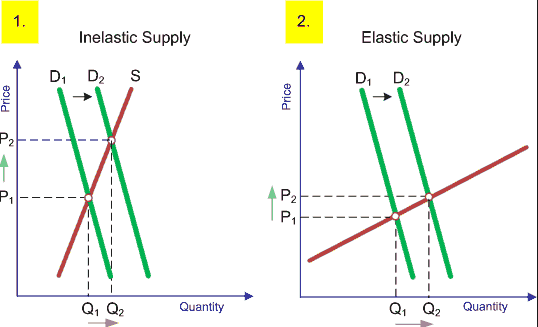
In the words of economists, the supply curve of steel is inelastic. It is very difficult to either increase supply, or decrease supply. Typically in market economics when the price of a good goes up, the ability to supply that good increases, causing the price to stabilize. The contrary is also the case when the price of good goes down, the market should cause players to leave the market, and lower the production.
The extreme capital intensive costs of steel production, combined with plants that cannot be turned on and off efficiently, means players cannot easily exit the market. When that happens there is an inelastic supply curve. The price of steel, is therefore, highly dependent on demand. When there is high demand the prices soar quickly. When demands tapers even a little, this leads to a precipitous fall in prices. Steel and aluminum production both have very high barriers to exit.
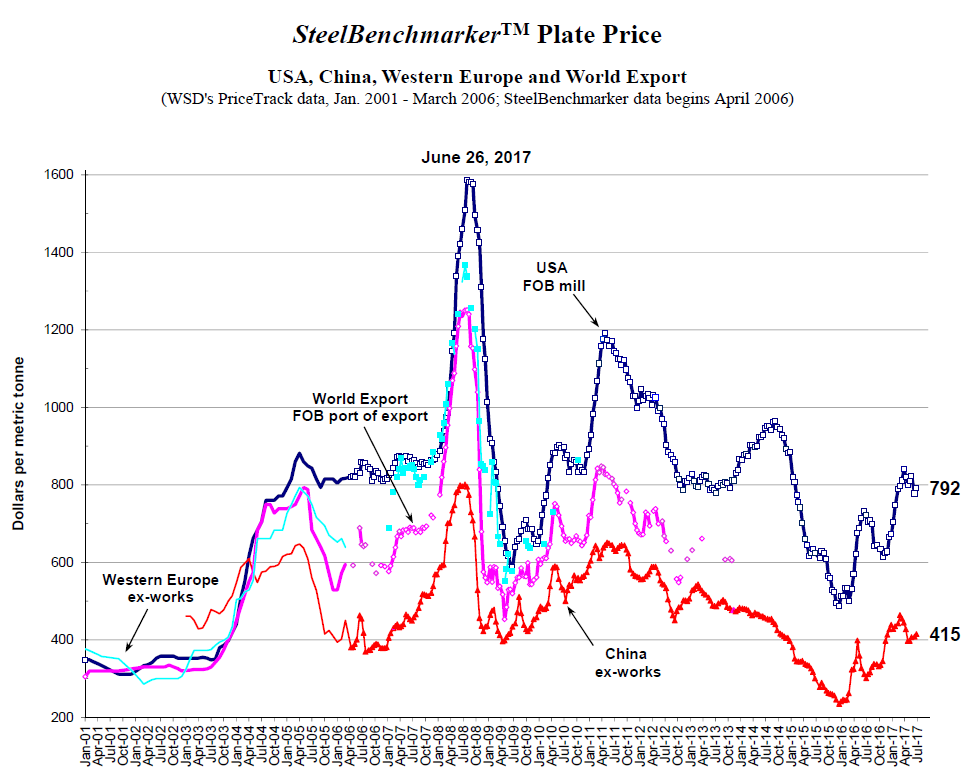
Plates steel world export FOB price for example ran up to a price of $1200 back in April 2008. By December 2015 (seven years later) the world F.O.B. price for steel had dropped to $375.00. If we were to imagine paying $6.00 for a loaf of bread one year and $1.85 seven years later, that is how inflexible steel production is. The key to steel price and profitability is demand. Aluminum is very similar. Demand creates large swings in prices.
Despite all the evidence to the contrary, people really believe that these price swings are a result of foreign supply and not demand. In testimony before the Steel 232 investigation hearing, Congresswoman, Marcy Kaptur, Democrat from Ohio stated, “America today faces a national steel crisis. Rising, unprecedented global overproduction coupled with unfair dumping threaten the viability of our United States' steel industry like few times before.”
She pointed to Duke University study in 2016 that China produces 2,300 million metric tons of steel while the global is only 1,500 million metric tons. She focuses on countries China, South Korea, Russia, and Vietnam. She points out that these countries are state run and the nations are subsidizing their steel industries. In the case of South Korea the state is subsidizing the electrical cost. The study was funded by the Alliance for American Manufacturing a Washington DC based lobbying group.

What is Likely to Happen.

The nature of these investigation is quite novel. So far there have only been two investigations initiated by the President himself. One resulted in the commerce department finding no threat to national security. The other resulted in Sanctions against Libyan Oil only. Clearly the President has some power to steer these investigations, to get the results he wants.
The auto market for in the US is expected to decline. New auto sales are one of the major uses of new steel. If United States auto demand drops, this could lead further to the loss of steel jobs and lower of steel prices. Lower prices will create more pressure on the industry to close plants and more belief that the national security in steel is at stake.
In 2001, there was a similar Section 232 Investigation on steel. Commerce determined steel imports did not threaten the U.S. national security. No action was taken. The demand for steel for the National Defense was 325,000 tons per year. Today the US produces around 1,750,000 ton per week. At present and or the foreseeable future, there is plenty of domestic production to meet the requirements of national defense.   
Increased demand will save steel profits. There is already some evidence of both increasing prices and increasing demand in emerging markets. If the largely expected infrastructure spending is passed along, with strong buy America provision, it will likely to shore up demand and increase prices for steel and aluminum.
For the past ten years, the United States imported on average 25 billion dollars in steel products. In that same period, the US exported on average 18 billion dollars. The only year the US had a trade surplus of steel products was when the price dropped, after the 2008 housing market crash. There was a precipitous drop in steel prices that year, and ironically enough an export surplus of steel products.
Furthermore, there are other facts making it hard to argue that sanctions are necessary for national defense. China has actually been cutting production, while raising consumption, of their own steel. Imports of steel from China have dropped over the past two years. The drop started after antidumping and countervailing duties were placed on steel products. These trade remedies seem perfectly apt to protect the United States Steel producers.
It is difficult, to make the argument, additional sanctions are necessary for national security. Compounding the problem for the administration is that the political appointee, who could steer the investigations toward a more political outcome, the Undersecretary for Industry and Security, has yet to be nominated. Acting Undersecretary, Daniel Hill, is currently running the investigations. The Secretary of Commerce, Wilbert Ross, is the only Trump appointee who could be involved in politicizing the investigation.
Even if nominated tomorrow, the average confirmation period is 45 days, the investigation will be halfway over, before the nominee takes office. The administration is left with, Daniel Hill, a Bush appointee, and longtime civil servant. It is doubtful career civil servants would steer the investigation to an incorrect, but expedient political, result. The Commerce Department has until January 2018, to issue it’s report. However, in public hearings, Commerce Secretary Ross claimed the they had no intention of using all 270 days to finish the report and claimed he thought they should be done before the end June.  It is now July.

Judicial Review.

One largely uncharted territory with the Section 232 Investigations, is whether or not, and to what degree, could any 232 sanctions be challenged legally. Prior to now there has never been any need for judicial review. It is clear, separation of powers should guarantee, some kind of judicial review. Based on the above information, there are serious questions as to whether any 232 sanctions are actually needed for national security.    
Typically, when a law allows the executive branch the ability to investigate and issue a rule the executive branch is afforded “Chevron” deference. Meaning the Court, will uphold the administration's rule, so long as it is not ‘arbitrary or capricious.’ Section 232 sanctions under these circumstances, could very well fail arbitrary and capricious standard.
However, the nature of a 232 sanction, is national security. The standard of review of the President's National Security decisions might be based on “facially legitimate and bona fide” justification of protecting national security. That might be more difficult to challenge. The administration just has to show a legitimate justification. Without looking too deep, into whether or not, the justification is real.  
If the court somehow upholds section 232 sanctions, or remedies, the last option would be for affected nations to file with the World Trade Organization’s Dispute Resolution Body. Any sanctions created under Section 232, would not likely be in accordance with the United States World Trade Organization obligations. However, it would  take years of dispute resolution, before any retaliatory sanctions could be placed on the United States, which would prompt the United States to drop the section 232 remedies.

Conclusion.

Section 232 of the trade act of 1962, has rarely been used, and for the most part, has had no effect on trade. It is striking how quickly the new administration pushed the Section 232 Investigations. There is evidence of a severe threat to domestic production which would threaten the United States national security. These investigations appear to be politically motivated. The outcome is unpredictable. Judicial review is limited. World Trade Organization disputes will take many years to resolve any ill conceived sanctions. It is possible, no matter how unlikely, that these investigations might result in serious challenges to trade.


Tuesday, February 16, 2016

Get Ready for FDA's New Foreign Supplier Verification Program.


Foreign Supplier Verification Program.
            In 18 months, June 2017,  the Foreign Supplier Verification Program will be mandatory for importers. Importers or their US Agents will have to have documentation on hand at the ready, that they have developed a Foreign Shipper Verification Program, for each they product import.  These programs will most require a number of enumerated documents, 1) Hazard Analysis, 2) Foreign Supplier Evaluation,  3) Verification of Activities, and 4) Corrective Actions. There are different rules for foods from very small importers from very small  suppliers, and dietary supplements.  There are also several exemptions and consequences of non compliance.
1.    Hazard Analysis.
            The importer or the US agent must identify and list all the hazards reasonable likely to cause illness or injury. There are three types of hazards to identify:  1) biological, chemical, and physical. Then the importer or agent must analyse how they could occur, either naturally, unintentional or intentional for economic gain. In order to do this analysis an importer must employ or outsource a qualified individual. A person with adequate, experience, education or training to conduct such analysis.
Finally the importer must evaluate these hazards, list the controls in place to prevent hazards, and evaluate the likelihood and severity of illness if these controls were not in place. The following factors must be considered for each hazard evaluation. The formulation of the food,  the equipment used to process the food,  raw materials used, transportation practices, harvesting s, raising processing, the packaging, labeling, storage, distribution intended use, foreseeable use, sanitation, hygiene, and any other factors. 
An importer may have a third party perform this analysis, or rely on the customer doing their own analysis, but they must independently review the analysis for themselves. then they must document that they reviewed it. However, imports of raw agricultural goods, fruits and vegetables, needs to follow extensive rules for fruits and vegetables.
With the exception of fruits and vegetables, if there are no hazards requiring control, importers do not need conduct a foreign supplier evaluation for approval or verification of activities. Nonetheless, they must document conducting the hazard analysis described.  
2.    Foreign Supplier Evaluation for Approval
After completing the hazard analysis every imported of food, the importer must evaluate the foreign supplier, and approve or refuse the foreign supplier. Everything that hazard analysis identified as requiring controls must be addressed. The importer must review the foreign supplier’s procedures process and practices compare those with current FDA safety regulations. They must also review the foreign supplier safety history. all of this again must be documented.  
This review may also consider regulations and safety procedures of the country from which the manufacture is located, if FDA recognizes the exporting country as comparable or equivalent to the U.S. FDA standards. The importer will be required to have information about these plus and testing results, audits, and the foreign supplier responsiveness in correcting problems. Again, all of this evaluation must be documented. 
3.    Verification of Activities.
            After identifying hazards controls, process and procedures of foreign suppliers, the importer will then be responsible for verifying these results. This maybe in the way of quality testings, on site visits, review of safety records, and any other ways, to verify the foods safety and hazards are minimized. The risks, and severity of illness or injury, must be evaluated to determine the frequency of each review. The default will require at least annual reviews, on site audits, and lab tests. Less frequent audits may be warranted only if the results of the Foreign Supplier Evaluation indicate it would be appropriate. 
            Importers may use the services of qualified third party providers to run these test. Importers may rely on outside audits, conducted by authorized parties, other that the foreign supplier. However, importer must document their review and assessment of appropriateness of the the third parties verification activities. Included in that review must also determine the party conducting the review was a qualified individual.
4.    Correction Actions.
            Finally if any hazards are found, or if there is a chance of persisting to cause illness or injury, the importer must also document all corrective actions that are taken to prevent risks. Importers must review, verify, and update the Foreign Supplier Verification Program if a new corrective action is taken.
If it is determined, through the verification activities, that a supplier does not produce food in compliance with safety standards the importer must take steps to discontinue accepting food from that supplier, or if it possess a risk conduct a recall. Importers also must have a documented recall plan.
            The consequences for not documenting a Foreign Supplier Verification Program include refusal of admission of those foods items from being imported into the US. Another consequence may also be a mandatory recall of that food item. All the records may be kept electronic form or in physical form but they must be available to be produced to the FDA upon request within a reasonable time. Failure to produce these records in a timely manner may result in refusal of admission of imported food.
Disclaimer and Exceptions
There are many exceptions and other inter threading rules. Each particular food item may have specific regulation addressing it. An Importer will need to examine each food item to address the regulations for that item. Such exceptions are seafood, alcoholic beverages, small importers, food not consumed without further processing, shell eggs, etc. It is likely every importer will need some more consultation.


Friday, December 28, 2012

I haven't posted in a while but I thought I should post an update on the GPX Tire Case.

I had thought the matter was closed once this judgement was handed down. I was under the impression that all China (NME) anti-dumping and countervailing cases from commerce would be remanded. In my article

However, I didn't follow the lobbying effort. After this case was decided the courts were over ruled by Congress. I found out about it from an article written here. Congresspassed a law retroactively allowing commerce to asses countervailing and anti-dumping duties on NME (mostly Chinese) imports.

So after that China has just filed with the WTO. the case was just started on December 17th 2012. Case DS449 will now run its long and winding course. It will be a long time before the case is heard. Longer before an decision. Then an appeal is likely followed by potential sanctions. After the sanctions then it will be up to the Executive Branch to change its policy back to Georgetown Steel Corp. v. United States, 801 F.2d 1308 (Fed. Cir. 1986).

Tuesday, October 5, 2010

GPX Tires. The end of CVD from NME's?

When this case was first decided and remanded to the agency, I thought then that it was pretty remarkable. See my blog from 2009. It was remarkable because the court decided that the when applying antidumping and countervailing trade remedies for non market economies, the margins for the additional duties could not be double counted. If they could not be double counted I did not see how they could be counted at all.

There are three types of trade remedies in US law: 1) countervailing remedies covered in 19 USC 1671, 2) antidumping remedies covered in 19 USC 1672, and 3) unfair practices cover under 19 USC 1337. Of these the first two are used most frequently. They both create the imposition of additional duties to products deemed in violation.

Countervailing duties are extra duties on the subsidies that the foreign governments give to their exporters.  For example, if a foreign government pays a company to export a product, then the amount of that payment is added on to the duty amount as a trade remedy. This balances out the government's subsidy so that companies can compete fairly despite that government's subsidy.

Antidumping duties are extra duties on products being imported, at less than fair market values, as determined by two different methods. The preferred method is the difference between the market price in the country of exports an the imported price. When there is not enough information to accurately establish a home 'market' price then a normal value may be constructed.Then the margin is the difference between the normal value and the imported price.

The second method of calculation antidumping duties is used when the economy the goods come from is considers a 'non market economy' or state controlled economies (NMEs). Then the price is constructed by using comparable surrogate prices,. In this method presumes that government meddling int he prices is so pervasive that the export market price is unreliable.

For many years the agency charged with enforcing the trade remedies refused to apply countervailing duties to antidumping cases, where the NME method of calculating  was used. Many US importers challenged this decision and the court ruled that is was a permissible interpretation of the statute, to refrain from imposing countervailing duties on products where, the NME method of calculating antidumping duties was used. (See Georgetown Steel) But he court in those years never said the agency could not apply countervailing duties only that is was within their discretion not to apply them.

In 2007 the Agency, Commerce Department, began trying to add countervailing duties to antidumping cases where NMEs were involved. Currently the major NME is China. Since then there have been quite a few cases of joint countervailing and antidumping cases being made against Chinese products. The GPX tire case is one of them.

The plaintiffs, US importers and Chinese importers, in this case challenged the Commerce Department's imposition of countervailing and antidumping duties arguing that it amounted to double counting of the countervailing duties. The court agreed in GPX I and remanded back to the agency to come up with an acceptable method to insure that the countervailing duties would not be double counted.

Well at long last the commerce depart has came back its chosen methodology and the court found that it was not able to prove that it could eliminate the double counting. In GPX II  the court found that the commerce department was not able to show it could eliminate the double counting and order the commerce department to forgo the countervailing duties.

The decision will likely be appealed and if the appellate agrees with the ITC it could mean the end of countervailing duties for all other Chinese countervailing cases as well.

This is a list of the current extra countervailing duties for goods from China. The list has the shipper names with duty rates. There are additional antidumping cases for these which are not listed.
  1. Circular welded stainless pressure pipe C-570-931
    1.  Countrywide rate 1.1%
    2. Winner Stainless Steel Tube 1.1%
    3. Froch Enterprises 299.16%
  2. Circular welded carbon quality steel line pipe C-570-935
  3. Citric Acid case C-570-938
    1. Countrywide 8.14%
    2. TTCA Cop., Ltd 12.68%
    3. Yixing Union Biochemical Co. 3.6%
    4. Anhui BBCA Biochemical 118.95%
  4. Prestressed Concrete Steel C570-946
    1. Countrywide 27.64%
    2. Fasten Group Import and Export 9.42%
    3. Jiangyin Hongyu Metal Products 9.42%
    4. Fasten Group Corporation 9.42%
    5. Jiangyin Walsn Steel Cable Co., Ltd. 9.42
    6. Jiangyin Hongshen Co., Ltd. 9.42%
    7. Xinhua Metal Products Co., Ltd. 45.85%
    8. Xinyu Iron and Steel Joint Stock Limited Company 45.85%
    9. Xingang Iron and Steel Joint Stock Limited Liability Corporation 45.85%
  5. Kitchen Appliance Shelving and Racks C-570-942
    1. Countrywide rate 13.3%
    2. GuangDong Wireking 13.3%
    3. Asber Enterprises 170.82%
    4. Ghangzhou Yixiong Metal Products Co., Ltd. 149.91%
    5. Foshan Winleader Metal Products 149.91%
    6. Kingsun Enterprises149.91%
    7. Yuyao Hanjun Metals Works 149.91%
    8. Zhongshan Iwatani Co. Ltd 149.91%
  6. Laminated woven sacks C-570-917 
    1. Country Wide 226.85%
    2. Shandaon shougang Jiayuan Chun Company Ltd 352.82 %
    3. Zibo Aifudi Plastic OPackaging Co. Ltd 29.54%
    4. Han Shing Chemical Co. Ltd 223.74%
    5. Ningbo Yong Feng Packaging Co., Ltd. 223.74%
    6. Shandong Qilu Plastic Fabric Group. Ltd 304.4%
  7. Lightwalled rectangular pipe and tube C-570-915
    1. Countrywide 15.28%
    2. Zhangjiagang Zhongyuan Pipe Making co Ltd 15.28%
    3. Kunshan Lets Win Steel Machinery Co., Ltd. 2.17%
    4. Qingdao Xiangxing Steel Pipe Co., 200.58%
  8. Lightweight thermal paper C570-921
    1.  Countrywide 13.63%
    2. Guangdong Guanhao High Tech 13.63 %
    3. Shanghai Hanhong Paper Co., Ltd 0%
    4. Shanzhen Yuanming Industrial Development Co., Ltd. 138.53%
    5. MDCN Technology 124.93%
    6. Xiamen Anne Paper Co., Ltd. 124.93%
  9. New Pneumatic Off Road Tires C-570-913 
    1. Countrywide 5.62%
    2. Guizhou Tyre Co., Ltd. 2.45%
    3. Tianjin United Tire and Rubber International Co., Ltd. 6.85%
    4. Hebei Starbright Tire Co., Ltd. 14% (GPX International Tire)
  10. Raw Flexible Magnets C-570-923 
    1. Countrywide 109.95%
    2. China Ningbo Cixi Import Export Corporation 109.95%
    3. Polyflex Magnets Ltd. 109.95%
    4. Jingzhou Meihou Flexible Magnet Company Ltd. 109.95%
  11. Sodium Nitrate C-570-926 
    1. Countrywide 169.01%
    2. Shanxi Jiaocheng Hongxing Chemical Co., Ltd. 169.01%
    3. Tianjin Soda Plant 169.01%
  12. Steel Grating. C-570-948
    1. Country wide 62.46%
    2. Ningbo Jiulong Machinery Manufacturing Co., Ltd. 62.46%
  13. Tow Behind Lawn Groomers C570-940 
    1. Countrywide 13.3%
    2. Princeway Furniture 0%
    3. Jiashan Superpower Tools Co., Ltd. 13.3%
    4. Maxcheif Investments Ltd 264.98%
    5. Qingdao Ea Huabang Instrument Co., Ltd. 264.98%
    6. Qingdao Hundai Tools Co., Ltd. 264.98%
    7. Qingdao Taifa Croup Co., Ltd. 264.98%
    8. World Factory Inc. 264.98%

Wednesday, April 7, 2010

Pottasium Phosphates Contervailing Duties

Commerce published their preliminary findings for countervailing duties for potassium phosphate salts imported from China.

Potassium phosphate salts are food additives and fertilizers. The order covers three types of these salts, one of which, monopotassium phosphate, is an ingredient in Gator Aid, for example.

The period of investigation is from January 1st 2008 to December 31st 2008.

Apparently both suppliers of these salts decided to stop selling potassium phosphates in the U.S. as Commerce claims both parties, and the Chinese government, did not respond to questionnaires aimed at determining whether there was dumping, and how much.

When parties shipping to the U.S. are charged with dumping the Commerce Department, or more specifically the Import Trade Administration (ITA), sends them questionnaires about pricing, costs, etc. They use the data collected from the questionnaires, other pricing data, and the dumping petition, to make determinations of countervailing margins and/or antidumping margins. The margins are percentages which translate into additional duties above the tariff schedule added to products already imported and imported in the future.When parties do not send back their questionnaires, partially fill them out, or send them back late, the ITA will then use the "adverse facts available" to find dumping or countervailing duties margins based on the assumption when in doubt the margin is higher.

When using "adverse facts available" the result should be a "reasonably accurate estimate of the respondent’s actual rate, albeit with some built-in increase intended as a deterrent to non-compliance. " F. Lii de Cecco Di Filippo Fara S. Martino S.p.a. vs. United States (App. Ct. Fed Cir. 2000) The ITA should make an accurate estimate of what the countervailing and anti-dumping margins should be and then add a little to punish the companies for not complying with the questionnaires.

So the rate should be "reasonably accurate." But in this case, for the potassium phosphate salts, the preliminary findings for only countervailing are a rate of 119% in additional duty. That means for every good that is exported, the Agency found that a reasonably accurate subsidy of 55% is being paid to the exporting companies by the Chinese Government. This seems quite improbable. For every dollar in exports the Chinese government is paying the exporting companies $0.55 of it.


Some of their methods used seem arbitrary. The findings showed China has a 33% income tax rate. But instead of figuring out the effect the income tax on the profit would be on the price of the exported product, they simply added 33% to the other subsidies. Income taxes are based on income which is revenue less expenses. The manner the ITA chose to make its calculations there would be no cost of production. I would like to run a business in whatever world the ITA is living in.

In addition to the absurdly high countervailing duty the ITA also has a concurrent non market economy (NME) antidumping duty case. Non market methods of calculation are done with countries such as China because government run companies have internal price controls making the domestic value unreliable. 

Because it is hard to tell where the company begins and the government ends the antidumping duty uses a method that catches that and all the government subsidies. But if the NME methodology catches the subsidies and the countervailing duty counts the subsidies then there will be double counting or doubling of countervailing margins by using both methods concurrently.  


Fortunately, for principle of fairness, if nothing else, the Court of International Trade (CIT) recognized this double counting was not correct. GPX Tires v. United States. CIT 09-103. The Court found it is permissible for the ITA to use both NME methodology for antidumping duties and make a finding of countervailing duties if they can come up with a methodology to insure that there is no double counting. I personally do not see how they will be able to do that. I think the only solution would be to apply countervailing duties only on the parts of the antidumping margin that do not use the NME methodology, or what has been termed the 'bubbles' of market economy within the the NME.

But the ITA does not co-ordinate the antidumping and countervailing investigations, other than trying to synchronize the schedule. They have the same data but they do not try to co-ordinate the determinations in a way that will avoid double counting as of yet. In this case especially they seem to be operating as if the above court decisions do no exist. Maybe they will fix it by the final determinations but it seems like they will keep doing whatever they want until challenged in court.


The importers of potassium phosphate salts for 2008 are the ones that might pay the penalty for this quagmire. If the Chinese government and companies who manufactured these potassium phosphate salts and exported them to the United States decided, like it seems, to just abandon the U.S. market at the hint of a injury investigation, then the importers are left holding the bag with little recourse.


The importers can and should make the challenges I mentioned above, but real amelioration of these margins in the help of real cost data from the suppliers would be much better. Finally results are due out over the summer and then we could be looking at litigation after that.

Friday, March 26, 2010

Zeroing Classic Conflict of Law and Rational.

After explaining what zeroing is here. Then explaining the legal background here. I now conclude with my personal critic of practice.

The idea that a dumping margin should be calculated by subtracting one average price by another not so average price is a little perverse. It breaks the rules of math. The amount the normal price exceeds the export price should equate to the amount the normal average price exceeds the export average price. Adding, subtracting or multiplying the same number or effect to each side of the calculation is the basis of algebra. The export price can not equate to the average export price, where not all prices are averaged but are altered to make some equal to the normal values, and the rest averaged. It breaks the rules of math, it makes apples oranges and grapes peaches. If the these rules were applied to everyday purposes planes would fall out of the sky and building would collapse.

The fact that this is somehow fine is linked the the permissible statutory interpretation doctrine from Chevron. Basically, there are words here, and they say something, but it is possible to read them differently. The two step process is, ask first if the words of the statute are ambiguous, then ask if the interpretation is permissible? Well the statute is almost always ambiguous. Otherwise why would it be challenged in court?  Then the interpretation is almost always permissible. It is much easier to find an interpretation permissive, than  not permissive. This is the deference given by the courts to the executive branch in interpreting statutes. Theory behind the deference to the executive branch in interpretation the statute is that if the executive branch interprets that differs from Congresses intent, Congress is in a much better place to correct them than the court politically and the executive is also more accountable as a political branch to the people than the court.

But in this case law of dumping duties is derived from a non-self executing treaty. Which means a treaty was negotiated, and instead of being adopted as law, Congress passes it into law as a US domestic law. Then the executive branch interprets the law. But usually, the executive and Congress, would prefer to interpret a treaty that benefits their domestic political base. If the executive chooses to interpret in a way the that penalizes unfairly foreign companies on behalf of U.S, domestic parties Congress is not about to pass a law to rectify it. So both the executive branch and the Congress have no, or limited interest, in trying to interpret a trade treaty fairly. The only branch left to interpret a statute based on a treaty fairly is the judicial branch. But if the judicial branch decides it best to leave the question to the political branches, as it does with other domestic law, then the only recourse left is external.

So faced with the inability to get a fair hearing in the United States system, the foreign companies must challenge the practice zeroing in the WTO dispute settlement body (DSB). But,  WTO rulings are not binding on the US courts, nor are they binding on the executive branch. The court defers again the the executive to uphold, or squirm around, WTO rulings, whichever it prefers. If the executive does nothing, or not enough, then the recourse, of the foreign interests is trade barrier retaliation. That sets off a trade barrier retaliation that is calibrated to cause enough damage to domestic industries, to get the domestic industries to pressure the executive the change the offensive policy. Is this anyway to run a railroad?

Obviously its no way to run a railroad. The zeroing interpretation should not have been held permissible in the first place. But like a kid who can not back down from a fight, when the WTO ruling against the practice came down, the US courts could not back down. There are plenty of reasons why a WTO DSB ruling should not be binding on a US court. Maybe using the Charming Betsy doctrine in conjunction with WTO ruling to change the executive interpretation of a treaty, also would set a bad precedent. But if all three branches of government have no interest in upholding trade treaty obligations then the only course will always be the WTO DSB and trade retaliation. Even in clear cut poorly interpreted statutes like this one.

The Court of International Trade prides itself, and rightly so, as one of the few courts in the world where foreign and domestic companies can come and challenge the enforcement of trade policy. It is better than most nations offer their trading parties. Many rulings are a testament to fairness. But it still would be better for the court to decide cases such zeroing in light that it is the last chance of fairness before the convoluted remedies WTO DSB are used.

Wednesday, March 3, 2010

History of Zeroing

Last blog entry I explained what "zeroing" was. I also knew, "zeroing" had been contested for a long time, but I was surprised to see how far back it went.

The earliest case I could find contesting the method of zeroing was, Serampore Indust. v. Dep't of Commerce. 11CIT 866 (1987). After that there was Bowe Passat Reinigungs-und Waschereitechnik Gmbh v. United States 20 CIT 558 (1996). In both these cases the use of "Zeroing" (explained in my previous blog entry) was considered a permissible interpretation of the statute. Both of these cases are too old for me to find online for free, so I would have to run down to my alma mater's law library, or pay to read them.

The standard of review on this is based on the reasonable interpretation statute know by many as the Chevron Doctrine. If the use of "zeroing" was a "finding" then the standard of review would have upheld Commerce's finding unless "unsupported by substantial evidence."   However, the us of zeroing was considered an "interpretation" of the statute. Under the Chevron Doctrine the courts will up hold the agency "interpretation" of an ambiguous statute if it is a "reasonable" interpretation.

The statute everyone is arguing about reads as follows: the "dumping margin is ... the amount by which the normal value exceeds the export price..." 19 U.S.C 1677. (emphasis added)  So the Commerce Department read that to mean that there weren't supposed to use any negative margins, i.e. only margins where the normal value "exceeds" the export price are written into the statute. See Timken Slip Op. 02-106. Now that might be fine if they weren't calculating margins using average prices over periods of a year. Because it just disregards the rules of math. The difference of one average between another average is the difference between the whole. The difference between one average and a construct is not the difference of the whole. It is apples and oranges being added together.

The first time the practice of zeroing was found inconsistent with WTO obligations, it was the European Union not the Untied States who was doing it. In 1998 India charged European Union was improperly calculating dumping margins by using zeroing in their calculations of bed linens from India. WT/DS141/AB/R. The WTO dispute settlement body, of course, has a different standard of review. It can look at the treaty and decide whether or not a practice is consistent or inconsistent with the treaty.It does not have to provide any deference to one side or the other.

But when applying the treaty to domestic law, the WTO treaty is not what they call "self executing." This means that after the executive branch negotiates the treaty, then they have to bring it back for United States for the Congress to write it into law domestic law. Some treaties negotiated and ratified by the Senate become US Law automatically and are on par with every other Federal law. U.S Const. art. II sect. 2 and U.S. Const. art.IV. But for the purposes of law, the much unjustly maligned WTO treaty, is actually more aspirational then it is binding on the United States.

Immediately after the WTO decision against the European Union, United States plaintiffs began trying to use it in U.S. Courts. See Timken (2002). Corus Staal (2003). The argument being the old "Charming Betsy Doctrine" that when interpreting U.S. law, courts will find that Congress intended the law to comport with accepted international law. See Murray v. Schooner Charming Betsy. 6 U.S. 64 (1804) (citing a U.S. Supreme Court case from 1804 is also pretty impressive.) Therefore an interpretation that is consistent with international law is reasonable and one that does not is not reasonable. If the WTO ruled that the interpretation of the statue is inconsistent with our treaty obligations then Congress must not have intended that and zeroing would not be a reasonable interpretation of the statute.

But the CIT for in both cases 1) the treaty doesn't specifically prohibit zeroing, 2) the Bed Linen case was not a reason enough to strike Commerce's interpretation, 3) WTO DSB decision are not binding on U.S. Courts and 4) WTO DSB decisions are not "self executing," they require Congress to change the law for them to have effect. Corus Staal Slip Op 03-25

So then the United States was challenged directly on it's use of zeroing this time by the European Union. WT/DS294/R. (2003) The EU hot off being called out on it's questionable antidumping practices immediately points its fingers elsewhere. The WTO DSB found U.S. zeroing practices specifically inconstant. End of the story right? Not quite. The DSB decision for all their worth only suggest other member to change their ways or face possible sanctions. They ndo not have the power to reach in and change any countries domestic law.

Plaintiffs again challenged zeroing  in court after the panel report in 2005 to no avail. See NSK Bearings v. Untied States Slip Op 05-1 . and then Corus Staal BV v. United States. Slip Op. 05-85. The same result that the court backed up Commerce's interpretation. The court was uhelp in both cases on appeal.

The U.S. appealed the WTO decision, and finally lost in the WTO appellate body, on April 18th 2006. So on March 6th 2006 commerce announced it would stop using the method of zeroing on new investigations. See 71 FR 11189. and then the final decision 73 FR 74932, Dec. 10, 2008. Commerce would start using average to average price comparison when calculating dumping margins in investigations. But it maintained it would continue to use zeroing on closed investigations under administrative review or sunset review.

Then not using Zeroing was challenged. In Searing Industries the court ruling that Commerce could refrain from using zeroing. Zeroing in initial investigations is no longer used and the Court has ruled that not using zeroing in initial investigations is also a reasonable interpretation if the statute. CIT. Slip Op -09-129.

But Commerce still uses zeroing in administrative reviews. These are dumping cases that have already had a final investigation and once a year they receive an annual administrative review if any of the parties request it. The use of zeroing in the administrative reviews was upheld by the court as well. See SKF v. United States. Slip-Op. 09-121


So the state of zeroing is that it is no longer used in the U.S. for investigations, but is still used in sunset reviews, new shipper reviews, and annual administrative reviews. 19 CFR 351.218, 19 CFR 351.214 , 19 CFR 351.213 and read with 19 CFR 351.414 (c) 1 and 2.

And that is were it stands. Zeroing may continue for much longer in the future. The last DSB ruling is a mixed bag and complicated the matter. It found certain measures the US took complied with the WTO finding and certain did not. Further, the appellate body previously allowed zeroing in context of reviews, while zeroing in investigations where "inconsistent." WTO DS294.

Wednesday, February 17, 2010

Latest Zeroing Cases

The latest two Zeroing cases added to a long history of Zeroing cases:

Dongbu Steel Co. Ltd. v. United States 2/4/2010 Slip Op. 10-13.
Corrosion-resistant carbon flat steel products from the Republic of Korea.
Use of zeroing in context of administrative review sustained. 
Andaman Seafood v. United States 2/4/2010 Slip Op.10-12
Frozen warm water shrimp from Thailand.
Sustained zeroing as commerce could apply the decision to stop using zeroing prospectively and not on already decided cases

"Zeroing" is a method used by the International Trade Administration in calculating "Antidumping Duties."

"Antidumping Duties" are extra duties levied on products being sent tot he US at less than fair market value. The two requirements are that a 1) US Industry is being injured by import and 2) the reason is that the injuring imports are being sold less than fair market value.

It is often explained as analogous to predatory price protection under Antitrust laws. However, the key distinction is that under anti trust laws the complainant must show that the offender has the intention of driving competitors out of business to recoup monopoly profits in the future. Antidumping is much easier to prove.

The remedy for dumping is additional duties calculated by figuring out what the fair market price should be and taxing the subject imports until they are that fair market price. So the difference between the higher 'fair market' price and the lower actually imported price is the dumping margin and the dumping duties. The higher the fair market price is when compared to the prices the foreign companies sell in the US the higher the duties.

"Zeroing" is a method of calculating the average price the foreign company sells the products in the United States. Over a period of time, the International Trade Administration the "Agency" averages the price in the home market, or fair market price, for a period of time usually a year. Then the Agency calculates the average sales price over time. Except, ever time that average sales price is over the fair market price the agency "zeros" it out to make it equal but not over the fair market price.

A brief example would be if month one the "home" market price is $3.00, then in month two it is $5.00, and in month three the price it $4.00. The average home market price for the three month period would then be $4.00. ((3+5+4)/3=4). Now lets say the same three month period the company sells the products to the US for the same price as the home market. Normally, there would be no dumping because the prices int he home market match the sales price to the US. But with the introduction of "zeroing" we have a different result. The $5.00 price would be "zeroed" out to the average home market price of $4.00. So the average sales price to the US becomes $3.66. ((3+4+4)/3=3.66) So where there should be no dumping the Agency finds a 9.2% dumping margin.

So when price of a product varies frequently, there is almost a guarantee there will be a dumping margin. The fair market price is arrived at by taking all the numbers and averaging them. The imported price is arrived at by taking all the numbers that are less than the fair market price and changing all the numbers that are high to the fair market price and then averaging them. You are always guaranteed to get a number less than the fair market price and hence always guaranteed to find a dumping margin.

More on the history of zeroing. Looks like this might be a three part blog series.

Friday, January 29, 2010

UPS Customs Brokerage Skates Free

In a brief 54 page opinion Judge Carmen doles out the what is hopefully the end of the on going saga which could be titled "UPS, Tricky Cathode Ray Classification and the Revenge of the Ten Factors."

For those who indulge in dry reading the novel chapters are as follows:
Chapter I  The Saga Begins: The Disputed Amount Will be a Mere Pittance.
Chapter II Plead to a Higher Power For Guidance on Hard Questions
Chapter III Hard Questions Are Best Left Unanswered
Chapter IV Cathode Ray Tubes Might be Everywhere: Let the Trial Begin.
Chapter V The Verdict is in Guilty: But the Hope Lives On.
Chapter VI The Tale of Ten Factors: Hard Questions Remain Unanswered.
Chapter VII The Fatal Gang of Ten Factors Let the Prisoner Go Free.

Will there be another Chapter? I certainly hope not.

I can't believe the end of this case. After Customs wins the ability to penalize a broker with a $75,000 fine, UPS appealed that decision, but also argued that that customs did not consider ALL of the ten factors listed in 19 CFR 111.1. when issuing the penalty.

Many, myself anyways, thought this would just then be sent back to the agency to reconsider all ten factors. (My blog from August 11th. Lawrence Friedman's Blog From August 13th.) Then after considering all ten factors it would go back to court with the same conclusion. So that finally the question of whether the maximum penalty issued to a broker can exceed $30,000.00 would be answered. I suppose we will never know that answer.

But now the Court concludes that if Customs failed to look at all ten factors at the time the penalty was issued then the penalty ab initio was faulty. The Court didn't say exactly that but the Court ruled the "failure was tantamount to a failure ... to meet its burden of proof." US CIT Slip-OP 10-11 at 53. This indicates that Customs must present at trial that it considered all ten factors before it can perfect a broker penalty.

UPS is off the penalty Scott free. My jaw dropped I was so stunned. I guess I need a life.

Why it took Judge Carmen 54 pages to come to the conclusion is another story. I suppose he likes to be thorough. 

Must congratulate the lawyers arguing for UPS. Picking up on the ten factors listed in 19 CFR 111.1 was a thorough job and a creative argument. Broker penalties will have to change. They are few and far between in the first place.

Will UPS try to claw back the penalties it already paid... Maybe the Saga is not over yet.